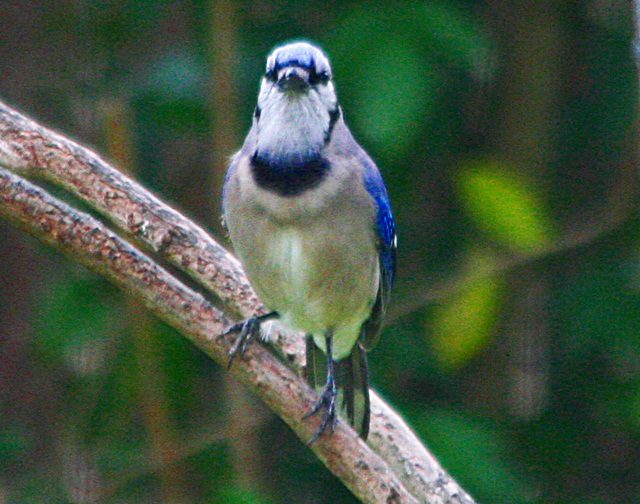
How did you spend your Presidents' Day weekend? I spent mine counting birds.
Yes, this was the weekend for the annual Great Backyard Bird Count, an activity that has now gone global. Beginning last year, the Count started accepting reports not just from North America but from all around the world. When I last checked the website, reports had been received this year from every continent except Antarctica. Participants count birds in their own yards or other designated places.
This year, I counted birds in my yard as I always do, and on Saturday I also did a count at Brazos Bend State Park. We had a family cookout there to celebrate our older daughter's birthday, and, of course, I insisted that we go on a bird walk after lunch.
In fact, the highlight of my weekend counting came on that walk. It was around 3:00 in the afternoon and we were walking around Forty-Acre Lake when we heard two Barred Owls calling to each other in the woods nearby. Since I do my bird counting during daylight hours, it isn't often that I get to list an owl species, but Barred Owls frequently become active in mid to late afternoon hours and, fortunately for me, these two certainly were!
I ended my day with 31 species counted at the park. With more time and effort, I could have probably doubled that, but, after all, birding was my secondary activity on this particular day.
On the other three days of the four-day holiday weekend, I observed and counted birds in my yard. My goal for the weekend was 40 species, but I ended with only 34. As always when I do an official count of birds in my yard, I was frustrated by the no-shows, the birds that I know are there but that just didn't turn up during my count period.
Where was that Pileated Woodpecker that has been so active in the area in recent weeks? Where are the Eastern Phoebes? I haven't seen one in my yard all winter. Where was the Red-tailed Hawk that flies over my yard every day - except for this weekend? That Killdeer that flies over and calls noisily on occasion - where was it this weekend?
And on most days I can count on flyovers in the late afternoon from a number of waterbirds and waders, but this weekend? Nary a one showed a feather.
Perhaps most frustratingly of all, the tiny Brown-headed Nuthatch did not make an appearance. I didn't even hear it calling during the time that I was counting.
For most of the weekend, I thought I would have to include the Yellow-bellied Sapsucker on my list of no-shows, but just at about 6:00 this afternoon as the light was fading and I was about to call it a count and head indoors, I heard the sapsucker calling in the big pine tree just across the fence in my neighbor's yard. I looked up and finally was able to find it far, far up the 100+ foot tree.
It was really too dark for this picture, but I had to give it a try after waiting so long for him.
Encouraged, I decided to wait just a few more minutes to see if something wonderful might turn up. Nothing did. My last bird of the day, the last bird of my count was that Yellow-bellied Sapsucker.
*~*~*~*
Here are the 34 species that did deign to show themselves for my yard count.
Black Vulture
Turkey Vulture
Cooper's Hawk
Sharp-shinned Hawk
Red-shouldered Hawk
Eurasian Collared-Dove
White-winged Dove
Mourning Dove
Inca Dove
Rufous Hummingbird
Red-bellied Woodpecker
Downy Woodpecker
Yellow-bellied Sapsucker
Blue Jay
American Crow
Carolina Chickadee
Tufted Titmouse
Carolina Wren
Ruby-crowned Kinglet
Eastern Bluebird
American Robin
Northern Mockingbird
Cedar Waxwing
Orange-crowned Warbler
Pine Warbler
Yellow-rumped Warbler
Chipping Sparrow
Northern Cardinal
Red-Winged Blackbird
Common Grackle
Brown-headed Cowbird
House Finch
American Goldfinch
House Sparrow
*~*~*~*
And here is the species list from Brazos Bend.
Blue-winged Teal
Northern Pintail
Pied-billed Grebe
Double-crested Cormorant
Anhinga
Great Egret
Snowy Egret
Little Blue Heron
White Ibis
Glossy/White-faced Ibis
Black Vulture
Turkey Vulture
Northern Harrier
Red-tailed Hawk
Common Gallinule
American Coot
Killdeer
Barred Owl
Red-bellied Woodpecker
Crested Caracara
Loggerhead Shrike
American Crow
Tree Swallow
Carolina Chickadee
Carolina Wren
Tufted Titmouse
Northern Mockingbird
Yellow-rumped Warbler
Northern Cardinal
Red-winged Blackbird
American Goldfinch
Come and experience the world of birds with me. You don't have to go far - just out your back door!
Blog stats
Showing posts with label GBBC. Show all posts
Monday, February 17, 2014
Tuesday, February 19, 2013
Wrapping up the Great Backyard Bird Count
Overall, it was a successful weekend of counting birds in my yard. I ended the four-day weekend with a total species count of 37. That was good enough for third place in Montgomery County (at least as I write this) and 56th in the state.
Here is my final list of the species that I saw in my yard or flying over it during the weekend, with the highest number of the birds seen at any one time:
1. Black-bellied Whistling Duck - 8
2. Snowy Egret - 1
3. Black Vulture - 2
4. Turkey Vulture - 5
5. Red-tailed Hawk - 1
6. Cooper's Hawk - 1
7. Eurasian Collared-dove - 1
8. White-winged Dove - 12
9. Mourning Dove - 1
10. Rufous Hummingbird - 2
11. Red-bellied Woodpecker - 1
12. Downy Woodpecker - 2
13. Eastern Phoebe - 1
14. Blue Jay - 2
15. American Crow - 4
16. Carolina Chickadee - 4
17. Tufted Titmouse - 2
18. Brown-headed Nuthatch - 1
19. Red-breasted Nuthatch - 1
20. Carolina Wren - 4
21. Ruby-crowned Kinglet - 1
22. Eastern Bluebird - 2
23. American Robin - 5
24. Northern Mockingbird - 1
25. Cedar Waxwing - 24
26. Orange-crowned Warbler - 1
27. Common Yellowthroat - 1
28. Pine Warbler - 3
29. Yellow-rumped Warbler - 5
30. Chipping Sparrow - 2
31. White-throated Sparrow - 1
32. Northern Cardinal - 8
33. Common Grackle - 100
34. House Finch - 1
35. Pine Siskin - 50
36. American Goldfinch - 33
37. House Sparrow - 5
As always, there were - frustratingly - several birds that I know were around but that just didn't show up for my count. Birds like the Inca Dove, Red-shouldered Hawk, Yellow-bellied Sapsucker, Pileated Woodpecker, and Brown Creeper. Oh, well, maybe next year...
I was also somewhat surprised to see that the 28 species that I recorded during our family picnic to celebrate my daughter's birthday at Brazos Bend State Park on Saturday were good enough to make me seventh on the Fort Bend County list - again, that is as I write this. More and lengthier reports may come in later.
It was a good weekend - most of it spent outside with the birds. What could be better?
Here is my final list of the species that I saw in my yard or flying over it during the weekend, with the highest number of the birds seen at any one time:
1. Black-bellied Whistling Duck - 8
2. Snowy Egret - 1
3. Black Vulture - 2
4. Turkey Vulture - 5
5. Red-tailed Hawk - 1
6. Cooper's Hawk - 1
7. Eurasian Collared-dove - 1
8. White-winged Dove - 12
9. Mourning Dove - 1
10. Rufous Hummingbird - 2
11. Red-bellied Woodpecker - 1
12. Downy Woodpecker - 2
13. Eastern Phoebe - 1
14. Blue Jay - 2
15. American Crow - 4
16. Carolina Chickadee - 4
17. Tufted Titmouse - 2
18. Brown-headed Nuthatch - 1
19. Red-breasted Nuthatch - 1
20. Carolina Wren - 4
21. Ruby-crowned Kinglet - 1
22. Eastern Bluebird - 2
23. American Robin - 5
24. Northern Mockingbird - 1
25. Cedar Waxwing - 24
26. Orange-crowned Warbler - 1
27. Common Yellowthroat - 1
28. Pine Warbler - 3
29. Yellow-rumped Warbler - 5
30. Chipping Sparrow - 2
31. White-throated Sparrow - 1
32. Northern Cardinal - 8
33. Common Grackle - 100
34. House Finch - 1
35. Pine Siskin - 50
36. American Goldfinch - 33
37. House Sparrow - 5
As always, there were - frustratingly - several birds that I know were around but that just didn't show up for my count. Birds like the Inca Dove, Red-shouldered Hawk, Yellow-bellied Sapsucker, Pileated Woodpecker, and Brown Creeper. Oh, well, maybe next year...
I was also somewhat surprised to see that the 28 species that I recorded during our family picnic to celebrate my daughter's birthday at Brazos Bend State Park on Saturday were good enough to make me seventh on the Fort Bend County list - again, that is as I write this. More and lengthier reports may come in later.
It was a good weekend - most of it spent outside with the birds. What could be better?
Monday, February 18, 2013
GBBC - Day 4
I feared that the excellent weather we had had for the last few days would not last and, indeed, today it ended. Much of the day was rainy and misty and windy, not good conditions for counting birds.
I didn't actually get outside to count until after 3:00 P.M., but then I stayed out until the sun set. Maybe I should have done that every day, because it turned out I had my best count of the weekend, ending up with 33 species on my list. Five of them were new for the weekend yard count: Red-breasted Nuthatch, Snowy Egret (flyover), White-throated Sparrow, Black-bellied Whistling Duck (flyover), and the star of my weekend, a Common Yellowthroat. In all the years that I have participated in this count, I have never before had a Common Yellowthroat on my yard's count.
Conditions were not optimal for photographing the birds, but I was able to record one visitor that I was very happy to see.
My favorite backyard dove, the Mourning Dove. They are pretty scarce in my yard these days, so it is always an event to have one drop in.
The bird was very wary and kept one eye on the sky, as well he should have because the Cooper's Hawk was on the hunt. A few minutes after I took these pictures, the hawk swooped in and the birds at the feeder, including my dove, exploded into the air. My heart was in my throat as I watched the hawk chase the dove. I felt sure that he was going to catch it, but then the dove swerved and made it to the safety of a tangle of vines and I realized I had been holding my breath as the hawk veered away, still hungry. I do realize that hawks have to eat, too. Just, please, not my Mourning Doves. Now, if it had been a White-winged Dove...
After that little drama, the yard was very quiet for several minutes. Finally, birds began to warily drift back to the feeders. One of the first was a White-throated Sparrow, the first one I had seen in the yard this weekend.
Late in the day, the largest flock of Cedar Waxwings I had seen this weekend - 24 - landed in one of my trees.
Three of the waxwings, their feathers ruffled by the wind.
Just as the sun was setting, a Snowy Egret flew over the yard, headed for his roost. Not long after, eight Black-bellied Whistling Ducks flew over, my last recorded species of the weekend. Unless I happen to hear/see an owl tonight.
I didn't actually get outside to count until after 3:00 P.M., but then I stayed out until the sun set. Maybe I should have done that every day, because it turned out I had my best count of the weekend, ending up with 33 species on my list. Five of them were new for the weekend yard count: Red-breasted Nuthatch, Snowy Egret (flyover), White-throated Sparrow, Black-bellied Whistling Duck (flyover), and the star of my weekend, a Common Yellowthroat. In all the years that I have participated in this count, I have never before had a Common Yellowthroat on my yard's count.
Conditions were not optimal for photographing the birds, but I was able to record one visitor that I was very happy to see.
My favorite backyard dove, the Mourning Dove. They are pretty scarce in my yard these days, so it is always an event to have one drop in.
The bird was very wary and kept one eye on the sky, as well he should have because the Cooper's Hawk was on the hunt. A few minutes after I took these pictures, the hawk swooped in and the birds at the feeder, including my dove, exploded into the air. My heart was in my throat as I watched the hawk chase the dove. I felt sure that he was going to catch it, but then the dove swerved and made it to the safety of a tangle of vines and I realized I had been holding my breath as the hawk veered away, still hungry. I do realize that hawks have to eat, too. Just, please, not my Mourning Doves. Now, if it had been a White-winged Dove...
After that little drama, the yard was very quiet for several minutes. Finally, birds began to warily drift back to the feeders. One of the first was a White-throated Sparrow, the first one I had seen in the yard this weekend.
Late in the day, the largest flock of Cedar Waxwings I had seen this weekend - 24 - landed in one of my trees.
Three of the waxwings, their feathers ruffled by the wind.
Just as the sun was setting, a Snowy Egret flew over the yard, headed for his roost. Not long after, eight Black-bellied Whistling Ducks flew over, my last recorded species of the weekend. Unless I happen to hear/see an owl tonight.
Sunday, February 17, 2013
GBBC - Day 3
When I first went outside to count birds this morning, I didn't take my camera with me, and thus I did not get to take a picture of the very first Orange-crowned Warbler that I have seen in my yard this winter. Sigh. Oh, well, at least I saw it, so I can include it on my list for the day.
It's not much consolation, but I did later get to record the other two winter warblers in my garden, but that's no real feat since they are ubiquitous around the yard this season.
The Yellow-rumped Warbler enjoys visiting the suet cakes.
The Pine Warbler sometimes feeds on the ground on the seeds that have fallen there from the feeders above.
The Orange-crowned Warbler was one of five "new" species to go on my yard list for the weekend. The others were Red-tailed Hawk, Eastern Phoebe, House Finch, and Black Vulture. That brings my total species count for the yard to 32, but I'm still jonesing after maybe ten more species that I know are around but that have been elusive over the last three days. The Red-breasted Nuthatch, for example. He's been around all winter, but when I really want to see him, he disappears! Where are you, my little friend?
The Eastern Bluebirds have been a lot more cooperative, showing up for me every day of the count. The reason is simple: These birds are already nesting! This is the earliest I've ever known them to nest in my yard. Last year and the year before it was May before they had their first brood. Here, the female of the pair looks out from the nest box they've selected for this year's family.
American Goldfinches are no challenge to photograph. They are everywhere!
And, of course, so are the Northern Cardinals, but I never get tired of them. Here, a male scarfs down a seed he has just shelled.
The young male Rufous Hummingbird is ever-present, also.
Pine Siskins continue to be the most numerous birds in my yard. They show no signs of getting ready to leave yet, but most likely they will be on the move within the next month.
So, one more day to try to add to my total. At least this year we've been blessed with good weather so far - although I could have done without that cold wind today. What will tomorrow bring? Something good, I hope.
It's not much consolation, but I did later get to record the other two winter warblers in my garden, but that's no real feat since they are ubiquitous around the yard this season.
The Yellow-rumped Warbler enjoys visiting the suet cakes.
The Pine Warbler sometimes feeds on the ground on the seeds that have fallen there from the feeders above.
The Orange-crowned Warbler was one of five "new" species to go on my yard list for the weekend. The others were Red-tailed Hawk, Eastern Phoebe, House Finch, and Black Vulture. That brings my total species count for the yard to 32, but I'm still jonesing after maybe ten more species that I know are around but that have been elusive over the last three days. The Red-breasted Nuthatch, for example. He's been around all winter, but when I really want to see him, he disappears! Where are you, my little friend?
The Eastern Bluebirds have been a lot more cooperative, showing up for me every day of the count. The reason is simple: These birds are already nesting! This is the earliest I've ever known them to nest in my yard. Last year and the year before it was May before they had their first brood. Here, the female of the pair looks out from the nest box they've selected for this year's family.
American Goldfinches are no challenge to photograph. They are everywhere!
And, of course, so are the Northern Cardinals, but I never get tired of them. Here, a male scarfs down a seed he has just shelled.
The young male Rufous Hummingbird is ever-present, also.
Pine Siskins continue to be the most numerous birds in my yard. They show no signs of getting ready to leave yet, but most likely they will be on the move within the next month.
So, one more day to try to add to my total. At least this year we've been blessed with good weather so far - although I could have done without that cold wind today. What will tomorrow bring? Something good, I hope.
Saturday, February 16, 2013
This week in birds - #57: GBBC, day 2
This week, instead of doing my usual roundup of the week's news stories about birds and the environment, I'm going to focus on the Great Backyard Bird Count, which went international this year and is now receiving reports on birds from around the globe. It's fascinating to watch the maps light up as new reports come in from the far corners of the earth.
My own bird count took place in two separate areas today. I started the day early in my own yard and ended the day late in that same yard, but, in between, I spent most of my day at Brazos Bend State Park, one of my favorite places to bird. It gave me a chance to see and report, and also photograph, something other than backyard birds. It was a gorgeous day for it, if a bit cool, and I was able to get a few reasonably good pictures, which is always satisfying.
This Great Egret was watching very closely as that white bird on the right, a White Ibis half hidden by foliage, was extracting some juicy tidbit from the water.
As usual, there were plenty of Double-crested Cormorants around. This one perched on a tree limb to do his preening.
A Yellow-rumped Warbler shows you how he got his name!
The Pied-billed Grebes were numerous. This one actually stayed above water long enough for me to take his picture. They usually dive immediately after I notice them.
This Common Gallinule was too busy with his preening to care that I was snapping his picture.
A couple of pairs of Blue-winged Teal seemed to be feeling quite amorous this afternoon. Here is one of the pairs.
Vermilion Flycatchers seem to be turning up in our area more and more frequently. There was a time not so many years ago when you had to go quite a bit farther south to see one of these beauties.
This Anhinga was enjoying the warmth of the winter sun as he sat on a limb just above the water. These birds are sometimes colloquially known as "snakebird" or "water turkey." When they swim, they extend their long neck and beak above the water while the rest of their body is submerged. I suppose to some they look like a snake, or perhaps a turkey, swimming.
The American Coot. Look at those wonderful toes! They help him walk on aquatic vegetation.
White Ibises were very plentiful in the park today. In the past, I've seen White-faced Ibis and even occasionally a Glossy Ibis here, but not today.
A small flock of White-throated Sparrows were going after the fruit on this tree, which seemed to be some kind of wild cherry.
I ended my day at the park with a species count of 28. Then I returned home and finished up my backyard count for the day. Here, I was able to count 21 species, including four that I had missed yesterday: Cooper's Hawk, Eurasian Collared-dove, American Crow, and Northern Mockingbird. That brings my two-day species count for my yard to 27. Tomorrow, I hope to be able to add a few more of the missing to my count.
So, are you counting birds this weekend? And if so, how's it going?
My own bird count took place in two separate areas today. I started the day early in my own yard and ended the day late in that same yard, but, in between, I spent most of my day at Brazos Bend State Park, one of my favorite places to bird. It gave me a chance to see and report, and also photograph, something other than backyard birds. It was a gorgeous day for it, if a bit cool, and I was able to get a few reasonably good pictures, which is always satisfying.
This Great Egret was watching very closely as that white bird on the right, a White Ibis half hidden by foliage, was extracting some juicy tidbit from the water.
As usual, there were plenty of Double-crested Cormorants around. This one perched on a tree limb to do his preening.
A Yellow-rumped Warbler shows you how he got his name!
The Pied-billed Grebes were numerous. This one actually stayed above water long enough for me to take his picture. They usually dive immediately after I notice them.
This Common Gallinule was too busy with his preening to care that I was snapping his picture.
A couple of pairs of Blue-winged Teal seemed to be feeling quite amorous this afternoon. Here is one of the pairs.
Vermilion Flycatchers seem to be turning up in our area more and more frequently. There was a time not so many years ago when you had to go quite a bit farther south to see one of these beauties.
This Anhinga was enjoying the warmth of the winter sun as he sat on a limb just above the water. These birds are sometimes colloquially known as "snakebird" or "water turkey." When they swim, they extend their long neck and beak above the water while the rest of their body is submerged. I suppose to some they look like a snake, or perhaps a turkey, swimming.
The American Coot. Look at those wonderful toes! They help him walk on aquatic vegetation.
White Ibises were very plentiful in the park today. In the past, I've seen White-faced Ibis and even occasionally a Glossy Ibis here, but not today.
A small flock of White-throated Sparrows were going after the fruit on this tree, which seemed to be some kind of wild cherry.
I ended my day at the park with a species count of 28. Then I returned home and finished up my backyard count for the day. Here, I was able to count 21 species, including four that I had missed yesterday: Cooper's Hawk, Eurasian Collared-dove, American Crow, and Northern Mockingbird. That brings my two-day species count for my yard to 27. Tomorrow, I hope to be able to add a few more of the missing to my count.
So, are you counting birds this weekend? And if so, how's it going?
Friday, February 15, 2013
Great Backyard Bird Count - Day 1
The birds had to start without me this morning. I was a late riser and the dawn chorus had long since ended by the time I managed to drag myself out of dreamland and into the outdoor world.
But, as it happens, in my dreamscape, I was seeing birds. I often dream of birds so perhaps it wasn't strange that I should be seeing them in my dreams on the morning when I should have been outside counting them. The thing is they were very vivid. There was a Northern Cardinal. There was an exotic bird - Indian, I think -whose name I couldn't dredge up. And there was a particularly detailed Great Horned Owl who sat in a hollow tree and blinked his eyes at me. Too bad I can't include dream birds in my count. I would love to report a Great Horned Owl.
Outside, many of the usual suspects were around. I ended the day with a species count of 23. There are at least a dozen more common species that I've seen around the yard this week who didn't show themselves today. Maybe they will turn up before the count ends on Monday. Meantime, here are the ones that I saw today, in the order that I saw them.
1. Turkey Vulture
2. Northern Cardinal
3. American Goldfinch
4. Pine Siskin
5. Rufous Hummingbird
6. Pine Warbler
7. House Sparrow
8. Red-bellied Woodpecker
9. Carolina Chickadee
10. Blue Jay
11. Tufted Titmouse
12. Mourning Dove
13. Eastern Bluebird
14. Chipping Sparrow
15. American Robin
16. Common Grackle
17. Yellow-rumped Warbler
18. White-winged Dove
19. Carolina Wren
20. Downy Woodpecker
21. Brown-headed Nuthatch
22. Cedar Waxwing
23. Ruby-crowned Kinglet
My count was dominated by Pine Siskins. There were at least fifty of the noisy little finches present at the feeders. The goldfinches ran a close second.
The Carolina Chickadees were busily house-hunting today. As it happens though, this box already has a bluebird nest and one blue egg in it.
One of the two Rufous Hummingbirds that made it onto my count takes a sip from one of my feeders.
Late in the day, a small flock of Cedar Waxwings came calling. It was so late that the light was fading and conditions for photography were not optimum, but I couldn't resist trying.
Tomorrow I'll be counting in my yard again, but I also get to go to Brazos Bend State Park for a picnic, and, of course, I'll also be counting birds there! .
But, as it happens, in my dreamscape, I was seeing birds. I often dream of birds so perhaps it wasn't strange that I should be seeing them in my dreams on the morning when I should have been outside counting them. The thing is they were very vivid. There was a Northern Cardinal. There was an exotic bird - Indian, I think -whose name I couldn't dredge up. And there was a particularly detailed Great Horned Owl who sat in a hollow tree and blinked his eyes at me. Too bad I can't include dream birds in my count. I would love to report a Great Horned Owl.
Outside, many of the usual suspects were around. I ended the day with a species count of 23. There are at least a dozen more common species that I've seen around the yard this week who didn't show themselves today. Maybe they will turn up before the count ends on Monday. Meantime, here are the ones that I saw today, in the order that I saw them.
1. Turkey Vulture
2. Northern Cardinal
3. American Goldfinch
4. Pine Siskin
5. Rufous Hummingbird
6. Pine Warbler
7. House Sparrow
8. Red-bellied Woodpecker
9. Carolina Chickadee
10. Blue Jay
11. Tufted Titmouse
12. Mourning Dove
13. Eastern Bluebird
14. Chipping Sparrow
15. American Robin
16. Common Grackle
17. Yellow-rumped Warbler
18. White-winged Dove
19. Carolina Wren
20. Downy Woodpecker
21. Brown-headed Nuthatch
22. Cedar Waxwing
23. Ruby-crowned Kinglet
My count was dominated by Pine Siskins. There were at least fifty of the noisy little finches present at the feeders. The goldfinches ran a close second.
The Carolina Chickadees were busily house-hunting today. As it happens though, this box already has a bluebird nest and one blue egg in it.
One of the two Rufous Hummingbirds that made it onto my count takes a sip from one of my feeders.
Late in the day, a small flock of Cedar Waxwings came calling. It was so late that the light was fading and conditions for photography were not optimum, but I couldn't resist trying.
Tomorrow I'll be counting in my yard again, but I also get to go to Brazos Bend State Park for a picnic, and, of course, I'll also be counting birds there! .
Tuesday, March 20, 2012
It was a record-breaker!
The Cornell Lab of Ornithology has published its report of the highlights of this year's Great Backyard Bird Count. The biggest highlight of all is that it was a record-breaking weekend!
First of all, participants submitted an amazing 104,151 checklists with 17.4 million individual bird observations. New records for the number of checklists were set in 22 states and in 6 Canadian provinces. Throughout the North American continent and in Hawaii, participants identified 623 species of birds. It truly is wonderful what citizen science can accomplish.
The bird that was reported on more checklists than any other was our old friend, the Northern Cardinal.
This is the eighth consecutive year that the cardinal has appeared on the most checklists.
Following closely in second place was that loveliest of doves, the Mourning Dove.
The most numerous bird reported during this year's count, though, was the Snow Goose.
These two geese were not photographed during GBBC but were at Anahuac National Wildlife Refuge earlier this year.
One of the most astonishing counts was the one for Tree Swallows. They had never before appeared in the top-10 of the most numerous birds reported, but this year, they were number two, right behind the Snow Goose. This was due to a massive flock of the swallows, estimated at some two million birds, that were roosting in Ruskin, Florida.
Another highlight of this year's count, of course, was the irruption of Snowy Owls. They were reported throughout the Great Plains and south to Kansas. The owl's main prey in their Arctic home is lemmings, and in years when the lemming population crashes, the birds are forced to move farther south in search of prey. That is apparently what happened this winter.
Likewise, a crash in the production of seeds favored by redpolls brought the Common Redpoll and Hoary Redpoll farther south than they are normally seen. Some Common Redpolls were reported as far south as California. Moreover, the numbers of both Common and Hoary Redpolls that were reported in Canada were down significantly this year because the birds had moved farther south.
You can read all about these stories and others in the highlights report itself. And if you participated in the big count, give yourself a pat on the back. You were a record-breaker!
First of all, participants submitted an amazing 104,151 checklists with 17.4 million individual bird observations. New records for the number of checklists were set in 22 states and in 6 Canadian provinces. Throughout the North American continent and in Hawaii, participants identified 623 species of birds. It truly is wonderful what citizen science can accomplish.
The bird that was reported on more checklists than any other was our old friend, the Northern Cardinal.
This is the eighth consecutive year that the cardinal has appeared on the most checklists.
Following closely in second place was that loveliest of doves, the Mourning Dove.
The most numerous bird reported during this year's count, though, was the Snow Goose.
These two geese were not photographed during GBBC but were at Anahuac National Wildlife Refuge earlier this year.
One of the most astonishing counts was the one for Tree Swallows. They had never before appeared in the top-10 of the most numerous birds reported, but this year, they were number two, right behind the Snow Goose. This was due to a massive flock of the swallows, estimated at some two million birds, that were roosting in Ruskin, Florida.
Another highlight of this year's count, of course, was the irruption of Snowy Owls. They were reported throughout the Great Plains and south to Kansas. The owl's main prey in their Arctic home is lemmings, and in years when the lemming population crashes, the birds are forced to move farther south in search of prey. That is apparently what happened this winter.
Likewise, a crash in the production of seeds favored by redpolls brought the Common Redpoll and Hoary Redpoll farther south than they are normally seen. Some Common Redpolls were reported as far south as California. Moreover, the numbers of both Common and Hoary Redpolls that were reported in Canada were down significantly this year because the birds had moved farther south.
You can read all about these stories and others in the highlights report itself. And if you participated in the big count, give yourself a pat on the back. You were a record-breaker!
Tuesday, February 21, 2012
Summing up this year's GBBC
So the big weekend of counting birds is over. My final species total for my yard was thirty-two, not the best year that I've had but not bad, particularly considering that the weather was not that cooperative. These are the birds that showed up for the count:
- Black Vulture
- Turkey Vulture
- Red-tailed Hawk
- Red-shouldered Hawk
- Killdeer
- Eurasian Collared-dove
- White-winged Dove
- Mourning Dove
- Rufous Hummingbird
- Red-bellied Woodpecker
- Downy Woodpecker
- Eastern Phoebe
- Blue Jay
- American Crow
- Carolina Chickadee
- Tufted Titmouse
- Carolina Wren
- Ruby-crowned Kinglet
- Eastern Bluebird
- American Robin
- European Starling
- Cedar Waxwing
- Pine Warbler
- Yellow-rumped Warbler
- Chipping Sparrow
- White-throated Sparrow
- Northern Cardinal
- Red-winged Blackbird
- Brown-headed Cowbird
- House Finch
- American Goldfinch
- House Sparrow
My most surprising visitor of the weekend was the White-throated Sparrow. I really hadn't expected that.
White-throated Sparrow, February 20, 2012.
Of the ten or so species that I know are here but that didn't turn up for the count, perhaps the most disappointing was the Northern Mockingbird. Four whole days of intensive birding and not one single mockingbird showed up in my yard!
Late this afternoon I walked out to my backyard to put my gardening tools away. When I opened the back door, the first thing I heard was a mockingbird singing. I walked outside and there he was at my back fence, singing his heart out, mocking me! He might have been saying, "Nah-nah-nah-nah-nah-nah! Can't count me!"
Darned mockingbird!
Monday, February 20, 2012
GBBC - Day 4
The final day of this year's Great Backyard Bird Count was gray, overcast, and chilly, not really the most pleasant day to be outside counting birds. As it turned out, we only had one pleasant day in this year's count and that was yesterday. Still, today actually had plenty of birds to offer. I ended the day with twenty-six species, only one less than yesterday, and I had three previously uncounted birds today. That brought my overall total for the weekend to thirty-two.
Today's new species were:
- Red-shouldered Hawk
- Eastern Bluebird
- White-throated Sparrow
Here are a few pictures of birds from today's count.
A pair of House Finches enjoys a late afternoon snack at the front yard feeder.
The male Northern Cardinals are obviously ready for spring. Their bright new feathers almost glowed on this gloomy day.
The smallest and cutest of the sparrow family, the Chipping Sparrow has been an infrequent visitor to my feeders this winter. Yesterday, I was happy to see a flock of a dozen at my front yard feeder. That was the biggest group I had seen here this winter. Today, I only saw two.
I was surprised to see a single White-throated Sparrow in the backyard this afternoon. These pretty little sparrows are not often seen in my yard.
A pair of cute little Downy Woodpeckers flirted around my backyard today. I tried to get a picture of them together but I could only succeed in getting the female to pose.
It's been a fun and exciting four days in spite of some dreary weather. Tomorrow, I will sum up the weekend and give you the final total species list for my yard for this GBBC.
Sunday, February 19, 2012
GBBC - Day 3
The yard was filled with sunshine and with birds on this third day of the Great Backyard Bird Count. I spent much of the day outside, working in my garden and counting birds, and I ended the day with twenty-seven species on my list!
The birds that turned up for the first time today were:
- Red-tailed Hawk
- Eurasian Collared-dove
- Mourning Dove
- Downy Woodpecker
- European Starling
- Cedar Waxwing
- Chipping Sparrow
- Brown-headed Cowbird
- House Finch
This brings my total for the weekend to twenty-nine species, but there are several that are still among the missing: Brown-headed Nuthatch, Eastern Bluebird, Orange-crowned Warbler, Purple Martin, and Northern Mockingbird just to name five. One more day - maybe some of them will show up tomorrow.
One of the two Rufous Hummingbirds wintering in my yard enjoyed the sun today.
The male Red-winged Blackbird from yesterday showed up again today and brought along his mate and several of his friends.
The Red-bellied Woodpecker didn't make an appearance yesterday but he was back today.
Best of all, the dapper little Cedar Waxwings came to visit.
I love watching these beautiful birds. They never fail to entertain me.
I wonder who will turn up to be counted tomorrow?
Saturday, February 18, 2012
GBBC - Day 2
Heavy rains this morning made this an even poorer day for viewing and counting birds than the first day of the Great Backyard Bird Count. We had 1.6 inches of rain in my yard today and have had almost four inches this week, so conditions are not optimal. Even so, any day of watching birds, even under less than ideal conditions, is a good day.
My species count for the day was a paltry 14, even less than yesterday, but I did manage to add one species to my overall total for the weekend.
A male Red-winged Blackbird hung around the backyard feeders all day today. Every time I looked, he was somewhere in the area.
He spent much of his time exploring the vines and shrubs along the back fence. He seldom showed his epaulets except when flying. Here you can see just a bit of the yellow on the wing but none of the red.
Most of my watching and counting today was done through my study window which looks out on the front yard bird feeder.
The Northern Cardinals like this feeder a lot and can be seen there throughout the day.
Here, a pair of them share a mid-afternoon snack.
The cardinals also share the feeder with the Carolina Chickadees.
Meanwhile, in the backyard...
A female cardinal shares the platform feeder with a White-winged Dove.
This is the only American Goldfinch I saw in the yard all day. Most of them really are gone!
I also saw this pair of UFOs (Unidentified Furry Objects) in my front yard today. Unfortunately, I couldn't find a place for them on my day's checklist.
With the addition of the Red-winged Blackbird, my species count for the weekend now stands at twenty. There are at least a dozen more species that visit my yard. I hope to see some of them tomorrow when the weather promises to be more friendly to bird-counters. (Fingers crossed!)
My species count for the day was a paltry 14, even less than yesterday, but I did manage to add one species to my overall total for the weekend.
A male Red-winged Blackbird hung around the backyard feeders all day today. Every time I looked, he was somewhere in the area.
He spent much of his time exploring the vines and shrubs along the back fence. He seldom showed his epaulets except when flying. Here you can see just a bit of the yellow on the wing but none of the red.
Most of my watching and counting today was done through my study window which looks out on the front yard bird feeder.
The Northern Cardinals like this feeder a lot and can be seen there throughout the day.
Here, a pair of them share a mid-afternoon snack.
The cardinals also share the feeder with the Carolina Chickadees.
Meanwhile, in the backyard...
A female cardinal shares the platform feeder with a White-winged Dove.
This is the only American Goldfinch I saw in the yard all day. Most of them really are gone!
I also saw this pair of UFOs (Unidentified Furry Objects) in my front yard today. Unfortunately, I couldn't find a place for them on my day's checklist.
With the addition of the Red-winged Blackbird, my species count for the weekend now stands at twenty. There are at least a dozen more species that visit my yard. I hope to see some of them tomorrow when the weather promises to be more friendly to bird-counters. (Fingers crossed!)
Friday, February 17, 2012
This week in birds - #9 (GBBC edition)
Here is this week's recap of news stories from the worlds of birds, science, and Nature. Click on the highlighted links to read the entire story.
*~*~*~*
Plans are well under way to establish wind farms off the Atlantic and Gulf Coasts to produce energy for the country. Although the turbines are designed to withstand high winds, a recent study indicates that hurricanes in some areas could present a high risk to the farms. The area that would be most at risk, according to the study, would be off the Galveston coastline.
*~*~*~*
A wind farm already in production, the Pine Tree site in the mountains of California, has had an unusually high mortality rate for birds. Golden Eagles have been the species most affected. Officials are trying to figure out why this is happening and how the situation can be ameliorated.
*~*~*~*
The extreme drought which Texas has been experiencing has degraded the winter habitat of the Whooping Cranes at Aransas, causing them to be more widely dispersed in the area than they have been in recent history.
*~*~*~*
The H5N1 virus, sometimes called bird flu virus, has been floating around as a concern for public health officials for several years now. Much research has been done on the virus, some of it has modified the virus and potentially made it even more dangerous. That research has now been suspended, but the World Health Organization has made the decision to release information regarding the research so that it will be available to other scientists. This is being done in spite of objections from the United States.
*~*~*~*
The little Northern Wheatear makes a remarkable migration from its breeding grounds in Alaska to wintering grounds in East Africa.
*~*~*~*
The Heartland Institute is a non-profit organization with a distinctly right-wing political bent. A cache of documents from the organization secured by an investigator shows that they are conducting a stealth campaign against the science of global climate change, including trying to influence how schools teach the science. Before Heartland became involved in denying that the earth is warming, they spent two decades denying that tobacco has any negative health effects and fighting against any government regulation of the substance.
*~*~*~*
Idaho is looking for ways to protect its population of Sage Grouse. Officials are in the process of writing new and stronger regulations for the bird's protection.
*~*~*~*
A new lizard species has been discovered in the Peruvian Andes. The lizard is very brightly colored in hues of red, yellow, and blue.
*~*~*~*
Bitterns are "booming" again in the United Kingdom and so is their population. The birds are recovering due to the protection and enhancement of their wetlands habitats.
*~*~*~*
About one-third of counties in the United States are expected to be suffering water shortages by the year 2050 because of the effects of global climate change.
*~*~*~*
Just to prove that all is not negative when it comes to exotic invasive species, the giant apple snail, which has become endemic in the Everglades because of the aquarium trade, is being eaten by an endangered bird, the Snail Kite. The new food source is helping to increase and stabilize the population of the threatened kite.
*~*~*~*
Around the backyard: This was the week that the goldfinches left! I had not been able to spend much time observing the birds this week but I had noticed that the thistle seeds were not disappearing as fast as they had been. Today, I was able to observe and count birds for a couple of hours before the rains started in the afternoon and it was clear to me that most of the goldfinches had moved on. I was only seeing one or two of the birds where previously there would have been twenty or more.
Today, of course, was the first day of the long-anticipated Great Backyard Bird Count. It was a gray, overcast day, not the best conditions for viewing the birds. At least the rain held off until late afternoon. My species tally for the day was nineteen:
- Black Vulture
- Turkey Vulture
- Killdeer
- White-winged Dove
- Red-bellied Woodpecker
- Rufous Hummingbird
- Eastern Phoebe
- Blue Jay
- American Crow
- Carolina Chickadee
- Tufted Titmouse
- Carolina Wren
- Ruby-crowned Kinglet
- American Robin
- Pine Warbler
- Yellow-rumped Warbler
- Northern Cardinal
- American Goldfinch
- House Sparrow
Here are a few of the pictures I took of visitors to the backyard feeders today.
This was the first year I've had a Rufous Hummingbird to report on my GBBC.
There were at least half a dozen Carolina Chickadees visiting the feeders at once.
There were a number of noisy Blue Jays at the feeders throughout the day, as well.
I never saw more than two American Goldfinches at the feeders at a time today.
There are always plenty of Pine Warblers at my feeders in winter.
And, of course, Northern Cardinals are abundant in my yard year-round.
That was day one. Tomorrow we are supposed to have some heavy rains again, but I hope I'll be able to count some of the birds that I missed in today's tally. Stay tuned!
Subscribe to:
Posts (Atom)