
Wednesday, June 27, 2012

Tuesday, June 26, 2012
Three beauties

I am a bit concerned because of the temperature. It was over 100 degrees yesterday, will be again today and is predicted to be again tomorrow. After that the heat is expected to abate just a little but it will still be in the high 90s. Is it possible the heat could damage the eggs, perhaps causing them to start developing before Mama is ready to brood? Could it perhaps even "cook" them? It is a concern, but, frankly, I don't know what I could do to alleviate the situation at this point. I'll just have to trust to Mama Bluebird and Mother Nature to know best how to take care of this new generation.
Monday, June 25, 2012
The bluebirds are nesting again
Before we went on vacation a couple of weeks ago, I noticed that the Eastern Bluebirds were showing interest in one of the bluebird boxes once again. I thought they were probably getting reading to build a second nest and raise another family. After we returned last week, I got sick with an upper respiratory infection and didn't get outside much during the week. Finally, over the weekend, I was able to make my rounds of the yard and check the nesting boxes and I found that, sure enough, the bluebirds had constructed one of their neat little nests made of pine straw in the old box where they have raised families in previous years. There were no eggs in the nest yet.
As I walked into the den this morning, I glanced out the window and saw the female bluebird exiting the box. I imagine she is ready to lay her eggs now and get on with the process of brooding a second clutch. I worry a bit about the birds because temperatures are supposed to be over 100 degrees for the first three days this week and there is little relief in sight. Being inside a wooden box in that sun, even with its ventilation holes, can't be very pleasant.
This pair of birds were very successful with their first brood of chicks, successfully fledging all four, so they are well experienced in raising a family. I hope their second venture is just as successful.
 The female bluebird visits the box where she has built her second nest.
As I walked into the den this morning, I glanced out the window and saw the female bluebird exiting the box. I imagine she is ready to lay her eggs now and get on with the process of brooding a second clutch. I worry a bit about the birds because temperatures are supposed to be over 100 degrees for the first three days this week and there is little relief in sight. Being inside a wooden box in that sun, even with its ventilation holes, can't be very pleasant.
This pair of birds were very successful with their first brood of chicks, successfully fledging all four, so they are well experienced in raising a family. I hope their second venture is just as successful.

Sunday, June 24, 2012

Saturday, June 23, 2012
This week in birds - #25
News from the world of birds and the environment this week:


(Photo courtesy of ABC.)
The Bermuda Petrel, commonly called Cahow after the sound that it makes, is the American Bird Conservancy's Bird of the Week. The bird is Bermuda's only endemic breeding species but was long thought to be extinct. In recent years, small populations of the bird have been found and conservationists are trying to protect it and encourage a comeback. It is still seriously endangered.
*~*~*~*
We know that the White-winged Dove is on the move, expanding its range right across the country. It was only a few years ago that the first of these doves appeared in my yard. Now they are the dominant doves here, having displaced the previous immigrants, the Eurasian Collared-dove. Now comes word that the White-winged has made it all the way to New Jersey!
*~*~*~*
Here's an oddment from the science news of the week: Nine turtle pairs died while copulating and their fossilized remains have now been discovered in Germany. It's the first known case of mating pairs dying in the act, being fossilized and then recovered. Scientists speculate that these turtles were going about their business in safe waters but while they were joined together they drifted into a toxic area of the lake and were killed.
*~*~*~*
Chinstrap Penguins are losing population in a warming world. The penguins depend on krill as their main source of nourishment and the krill are dying in warming waters. Less krill means fewer penguins.
*~*~*~*
In related penguin news, the four-foot-tall Emperor Penguin depends on the ice shelf around the continent of Antarctica as its habitat. As the planet warms and the ice melts, scientists are predicting a drastic decline in the population of these big penguins.
*~*~*~*
A species which had been thought for 133 years to be extinct has been rediscovered. The Kandyan dwarf toad has been found to be alive and well and living in Sri Lanka.
*~*~*~*
It's news when Kiwis fly and this week some of these normally flightless birds took to the air - with an assist from a military helicopter - as they were moved to a new habitat on the coast of New Zealand.
*~*~*~*
Carbon that is currently trapped in the Arctic tundra could be released, scientists say, by the growth of new trees in the warming area. This is of concern because it could further exacerbate global warming.
*~*~*~*
A study of Swamp Sparrows shows that baby sparrows prefer the songs which they can hear the clearest and adopt those into their own personal playlist. Thus, outside noises from human activities can obscure some sounds and thus affect the songs that the birds learn.
*~*~*~*
Coyotes have recolonized the Northeast displacing the red fox in many areas. The red fox is a voracious predator of the white-footed mouse which is a carrier of the ticks which produce Lyme disease. Coyotes prey on the mice, too, but not to the extent of the foxes. When the foxes disappear from an area, the mouse population expands and the cases of Lyme disease increase. These are the findings of a new study about the increasing number of Lyme disease cases in the Northeast, and thus does a change in the habitat of an area produce sometimes unexpected results.
*~*~*~*
Did you ever wonder how Brown-headed Cowbird chicks learn to be cowbirds? After all, they are raised by foster parents, so why don't they imitate the sparrows or warblers who have nourished them? Blogger Kate St. John has an observation about that and about the male cowbirds calling their now fully-fledged chicks to follow them.
*~*~*~*
Around the backyard:
Well, it's been a bit of a lost week for me. I've been laid low by a respiratory infection and unable to get out and about very much at all. I did finally get outside today to fill my bird feeders which had been empty for many days. Poor birds! Fortunately, there's no shortage of wild food for them.
Hardly had I gotten the seeds and suet and pressed seedcakes into their appropriate feeders before the dominant Northern Mockingbird was on top of the feeder pole proclaiming that this is his territory! Some of the other birds may have other ideas though.
While I was out filling the feeders, I was delighted to hear the song of the little Brown-headed Nuthatch in my neighbor's pine trees. It's not a song that I hear in my yard every day anymore and it always makes me happy when I do.
Friday, June 22, 2012


Tuesday, June 19, 2012
Mockingbirds everywhere!
We're back from our brief vacation, a road trip that took us through parts of Texas, Arkansas, Louisiana, and Mississippi on our annual visit to family and friends. Sadly, I cannot tell you that I saw any new birds anywhere along the way, just lots of the old friends that visit my backyard or the ponds, streams, and beaches that I sometimes visit at home.
I was surprised by the number of Yellow-crowned Night Herons I saw along the way. There seemed to be at least one present at every puddle and there were lots of puddles because rain had been plentiful in the areas where we traveled.
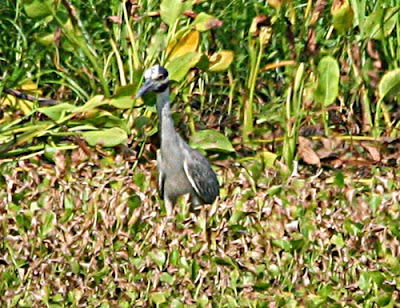
 In addition to adults like the one in the first picture, there were plenty of juveniles like this one, still dressed in the speckled feathers of the fledgling.
I was not at all surprised though to find Northern Mockingbirds everywhere we went, often busy feeding fledglings. I don't think we made a single stop along the way where there wasn't at least one mockingbird to greet us. This adaptable bird is doing just fine, thank you, all across its range.
 A Northern Mockingbird keeps a wary eye on things.
The most amazing avian sight that I saw on our trip was a big flock of Purple Martins circling just at dusk over our motel in Corinth, Mississippi. There were too many for me to accurately count, but there were well over a hundred, certainly the largest flock of these birds that I have seen this year. But in most of the places that we stopped in Mississippi there were big numbers of martins. Putting up gourds for martin housing is very popular there and the birds are happy to avail themselves of their traditional housing. I was very glad to see this favorite summer bird of mine, which no longer nests in my yard, doing so well in these areas.
I was surprised by the number of Yellow-crowned Night Herons I saw along the way. There seemed to be at least one present at every puddle and there were lots of puddles because rain had been plentiful in the areas where we traveled.


I was not at all surprised though to find Northern Mockingbirds everywhere we went, often busy feeding fledglings. I don't think we made a single stop along the way where there wasn't at least one mockingbird to greet us. This adaptable bird is doing just fine, thank you, all across its range.

The most amazing avian sight that I saw on our trip was a big flock of Purple Martins circling just at dusk over our motel in Corinth, Mississippi. There were too many for me to accurately count, but there were well over a hundred, certainly the largest flock of these birds that I have seen this year. But in most of the places that we stopped in Mississippi there were big numbers of martins. Putting up gourds for martin housing is very popular there and the birds are happy to avail themselves of their traditional housing. I was very glad to see this favorite summer bird of mine, which no longer nests in my yard, doing so well in these areas.
Subscribe to:
Posts (Atom)