We had our first light frost last night. The temperature got down to 32 degrees F. and it is still quite chilly outside today and expected to get back down to freezing tonight.
It's hardly like trying to survive a heavy winter storm, but the colder weather does put a bit of extra stress on the birds. Those of us who provide feeders for them need to make sure that those feeders are well-stocked, so that our backyard birds don't have to wander far afield looking for food. This benefits both the birds who visit our yards and the birds in the woods and fields that don't have to compete with "our" birds for food.
Remember, too, that more and more hummingbirds are sticking around in our area through the winter and we can help them by keeping those sugar water feeders clean and full. The little birds eat a lot of insects as well, especially at this time of year, but as the weather gets colder, fewer insects will be available and fewer flowers will be available, so it is important to keep those feeders up.
I found the little female Rufous today sitting on an exposed branch taking in some rays from the sun. Her feathers were all fluffed up against the cold. Rufous Hummingbirds are much more tolerant of cold than many of our hummingbirds. That's why when we see one in winter it is most often a Rufous.
Don't forget, also, the importance of water. Sometimes we forget that the birds need water in winter, too. I just looked out my study window and saw an Eastern Phoebe at my front yard birdbath and frequently these days I see American Crows using the bath as well. The point being that even those birds that are not necessarily feeder birds will make use of the birdbaths and other water sources that we provide in our yards.
Come and experience the world of birds with me. You don't have to go far - just out your back door!
Blog stats
Showing posts with label winter food. Show all posts
Tuesday, December 11, 2012
Thursday, December 8, 2011
Hungry finches
The weather has turned wintry and our favorite winter finches, the American Goldfinches, have started visiting our bird feeders.
Five goldfinches at the front yard feeder this morning.
I had not yet put up my thistle sock feeders. I always wait for that until I see the finches visiting the feeders, otherwise the thistle (nyger) seeds can hang there in the weather and grow stale before the birds start eating them and I have learned to my chagrin that finches will not eat stale seeds. But now that the birds are eating the black oil sunflower seeds, it's time to buy some fresh thistle seeds and get out the socks and hang them.
Not only are the goldfinches visiting the feeders, other birds are hitting the seeds buffet regularly this week. The drop in the temperatures has made them seek additional calories to help keep up their energy and keep warm. It's important for those of us who feed birds in our yards to make sure that the feeders are kept clean and stocked now. It's a particularly good idea now to offer foods with a high fat content. Most birds like suet. Many also like peanuts or peanut butter. If you only offer one type of seed though, the best choice is probably the black oil sunflower seed. These seeds, too, are fairly high in fat content and they are liked by perhaps the greatest variety of backyard birds.
Monday, September 19, 2011
Quiet time
It was a lot quieter in the yard today. Many of the migrants that had been a part of the scene over the last couple of weeks seem to have moved on. Not the hummers though. There were still perhaps ten of the little guys (as best I could count) hanging around today and chasing each other through the shrubbery, including the little tail-twitcher who might be a Black-chinned. The female Rufous that was here earlier, though, has definitely moved on.
The birds that remain, other than the hummers, are going about their business rather quietly. There are no extended bursts of singing, just a soft twitter now and then, unless the Blue Jays spy the Cooper's Hawk lurking about, of course. Then pandemonium reigns until the hawk is routed and sent on his way.
The birds are still hitting the bird feeders hard. After I refill them, the seeds last for about two days. Then it's time to fill up again.
I've noticed, too, that even some of the wild feed in my yard is disappearing more quickly than usual this summer.
The pokeberries, which are a soft berry much favored by Northern Mockingbirds, in particular, are long gone.
But I noticed just yesterday that the beautyberries, which are hard berries that usually last into winter, have already been devoured as well. I have several of the shrubs that have these purple berries and they are usually the last of the wild fruit to go. I suspect that not only the birds but some of the small mammals have been eating them this summer.
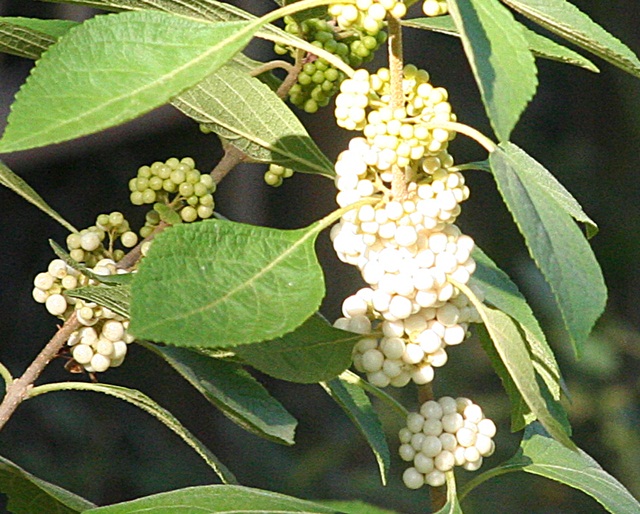
The birds, in the past, have shown a preference for the white variety of beautyberry. I only have one shrub which has the white berries and they were all picked clean by the middle of last week.
One seed crop which may be a boon to winter birds this year is the crape myrtle. The seeds of this ubiquitous shrub/tree are highly favored by members of the finch family and, in fact, by all of my backyard seed-eating birds. The crapes have been full of blooms this summer and should have an excellent crop of seeds this winter if we can just restrain gardeners from committing "crape murder" by topping their trees. It really is important to leave these seeds for the birds to eat. There'll still be plenty of time to prune your crape myrtle - if you insist on it - in the late winter.
The American Goldfinches generally spend weeks in the late fall picking out crape myrtle seeds before they ever turn to my thistle and sunflower seed feeders.
If you've got seeds or berries in your landscape plants, be sure you leave them for the birds and other animals to munch on. Don't even think of pruning them off now. This year, more than ever, wildlife will need them.
Subscribe to:
Posts (Atom)